


Single Acting Cylinders
Single acting cylinders are the perfect choice for
applications where gravity, weight or some other
assist force is available to move the cylinder in one direction.
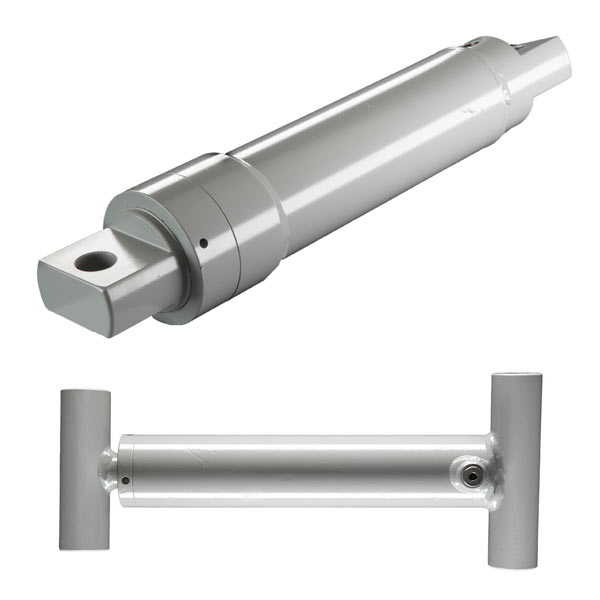
Single acting cylinders are often less costly
than double acting cylinders.
Single acting cylinders mount in any position, and are ideal for a
broad range
of industrial and mobile applications. Single Acting cylinders
come in two basic varieties: single acting
piston cylinders and single acting ram
cylinders. Single acting piston cylinders
most commonly use fluid power to generate force in one direction,
while gravity and the weight of the load being pushed or pulled
creates movement in the opposing direction.
Hydraulic pressure pushes against a sealed piston in one
direction. Air moves in and out of the cylinder on
the other side of the sealed piston. Single acting piston
cylinders can also incorporate a spring to facilitate
movement in one direction. Hydraulic force moves the cylinder in
one direction, which compresses the spring;
the spring, rather than gravity, then creates the pushback. Once
the pressure is stopped, the spring returns
the cylinder to its resting position. To

determine the amount of work single acting piston cylinders can do,
the following formulas apply:
When using the cylinder to push a load use (π x radius of piston2)
x operating pressure = weight of load
that can be pushed. When using the cylinder to pull a load use (π
x radius of piston2) - (π x radius of rod2)
x operating pressure = weight of load that can be pulled.
Because single acting piston cylinders use seals on the piston,
there is the potential for bypass.
While it is typical to use a breather fitting in the air port,
small leaks can appear from the breather,
even when the cylinder is operating optimally. It is always
advisable to run a small line back to the
hydraulic tank so that this small amount of oil stays within the
system. An alternative to single acting piston
cylinders is the single acting ram type cylinder.
This type does not
use internal seals for movement and only requires one port. This
type of cylinder can only use hydraulic
pressure to extend or push a load, while gravity and weight
collapse or retract the cylinder. A guide ring
is used to keep the rod traveling linearly without cocking. As
fluid fills the barrel, the rod is displaced. To
determine the amount of work single acting ram cylinders can do, the
following formula applies:
(π x radius of rod2) x operating pressure = weight of
load to be pushed. The single acting ram has a
simpler cylinder design with less potential leak issues, but can
become more costly because of its
larger diameter rod. While each application is
different, a general rule for a single acting piston cylinder and
single acting
ram cylinder is that the mounting pin-to-pin dimension will be 4
to 5 inches longer than the stroke of the
cylinder. For applications that need more stroke than this allows
for,
telescopic cylinders and
piggy-back cylinders can provide a solution.
Best Metal specializes in
hydraulic cylinder prototypes and offers a broad
range of
hydraulic
cylinder mounting options. Let us help with your
next application. |